
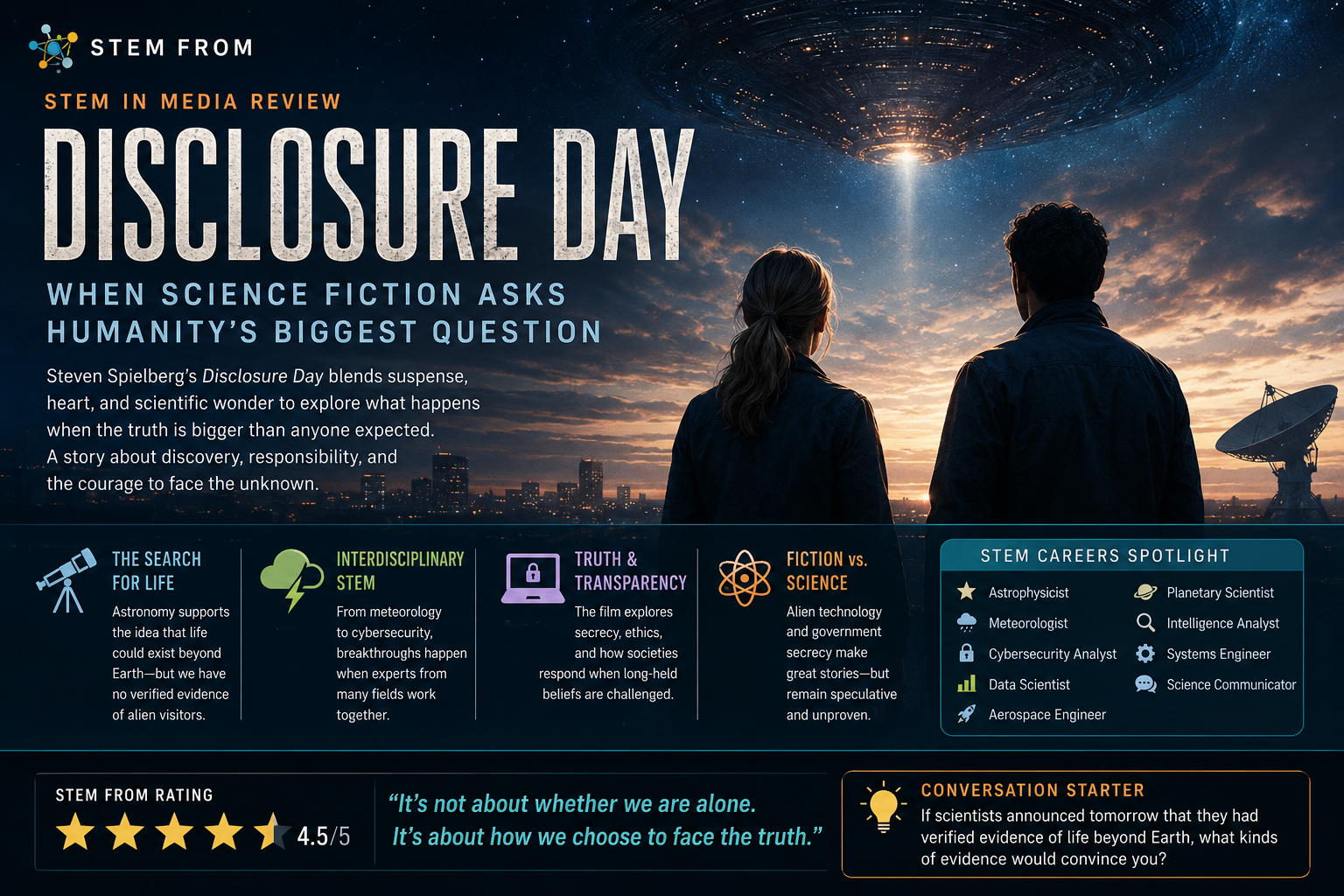
When Science Fiction Asks Humanity’s Biggest Question
Genre: Science Fiction | Mystery | Drama
Director: Steven Spielberg
Recommended Audience: High School (Grades 10+) through Adult
STEM Themes: Astronomy, Astrobiology, Atmospheric Science, Cybersecurity, Artificial Intelligence, Ethics, Government Transparency, Scientific Inquiry
————————
Review
Few directors have inspired audiences to look toward the night sky quite like Steven Spielberg. From Close Encounters of the Third Kind to E.T., his films have consistently explored humanity’s fascination with the possibility that we are not alone in the universe. Disclosure Day continues that tradition, but instead of focusing solely on extraterrestrial life, it asks a broader question: What happens when truth collides with fear?
The film follows meteorologist Margaret Fairchild (Emily Blunt) and cybersecurity expert Daniel Kellner (Josh O’Connor) as they become entangled in a global conspiracy surrounding evidence of non-human intelligence. Rather than delivering a traditional alien invasion story, Spielberg builds a suspenseful mystery centered on secrecy, ethics, and humanity’s readiness for profound scientific discoveries. Critics have praised the film for blending spectacle with optimism while emphasizing empathy over conflict.
What makes Disclosure Day particularly engaging is that it never loses sight of its human characters. The science-fiction elements serve as a backdrop for questions about trust, responsibility, and how societies respond when long-held assumptions are challenged.
————————
The Science Behind the Story
Like many excellent science fiction films, Disclosure Day mixes established science with speculative fiction. Understanding where those boundaries lie is what makes the movie especially valuable for STEM discussions.
What the Film Gets Right
- The Search for Life Beyond Earth
- Modern astronomy strongly supports the idea that the ingredients for life are common throughout the universe. Thousands of exoplanets have been discovered, including many that orbit within the habitable zones of their stars. Scientists continue searching for biosignatures and technosignatures using observatories like the James Webb Space Telescope and radio observatories participating in SETI research.
- Importantly, however, there is currently no verified scientific evidence that extraterrestrial civilizations have visited Earth.
- The film uses this uncertainty as the foundation of its mystery rather than claiming scientific proof.
- Scientific Curiosity
- One of the film’s greatest strengths is its portrayal of scientific curiosity.
- Scientists ask questions.
- They gather evidence.
- They challenge assumptions.
- They revise conclusions when better evidence appears.
- These principles mirror the scientific method and reinforce that science advances through evidence—not certainty.
- Interdisciplinary STEM
- The protagonists represent different STEM disciplines ranging from meteorology, cybersecurity, Data / Engineering, and physics (amongst many others).
- Modern scientific breakthroughs rarely occur within a single discipline. Instead, they emerge from collaboration across multiple fields, making this one of the movie’s more realistic portrayals. We have covered this in other blogs as well take a look here.
————————
Where the Film Becomes [Science] Fiction
- Government Secrecy
- The idea that governments possess definitive evidence of extraterrestrial civilizations remains speculative.
- Recent public discussions surrounding UAPs (Unidentified Anomalous Phenomena) acknowledge that some aerial observations remain unexplained. However, “unexplained” does not mean extraterrestrial. Scientific investigations have yet to produce publicly verified evidence demonstrating alien technology or non-human intelligence on Earth.
- The film uses secrecy as a dramatic device rather than a documented historical fact.
- Alien Technology
- Without revealing spoilers, the advanced technology featured in Disclosure Day exceeds anything currently supported by physics or engineering.
- Many science fiction films imagine:
- Instant communication
- Exotic energy systems
- Technologies that manipulate consciousness
- Physics beyond our current understanding
- While these ideas stimulate imagination, they remain speculative and unsupported by experimental evidence.
- Human Response
- Perhaps the most believable aspect of the film isn’t the aliens—it’s the people.
- History shows that revolutionary scientific discoveries often challenge existing beliefs. From heliocentrism to evolution to modern genetics, transformative discoveries frequently encounter skepticism before becoming accepted.
- Disclosure Day explores how fear, misinformation, politics, and hope might shape society’s reaction to extraordinary evidence. That social science dimension feels surprisingly realistic.
————————
Final Thoughts
Disclosure Day succeeds not because it claims to reveal hidden truths, but because it invites audiences to think critically about evidence, uncertainty, and the responsibilities that come with scientific discovery. The film wisely avoids presenting speculation as established science. Instead, it uses one of humanity’s oldest questions: “Are we alone?”
For educators, students, and STEM enthusiasts, this makes Disclosure Day an excellent conversation starter. It encourages viewers to distinguish between scientific possibility and scientific proof, a skill that is increasingly important in an era of rapidly evolving technology and abundant information.
Leave a Reply